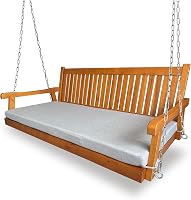
Porch Swing Dimensions: The Simple Answer
On this page (6 sections)
Porch swing dimensions are quite straightforward once you know what to look for. The most common size for a porch swing is 4 feet long, designed to comfortably seat two people. However, you can find swings ranging from 3 feet for cozy nooks to 6 feet for larger gatherings, so there’s a perfect fit for nearly any porch space.
Choosing the right porch swing dimensions often depends on your available space and how you plan to use it. If you prefer a woven seat, see our guide to wicker porch swing styles. Think about who will be sitting on it and how much room you need. Standard sizes are widely available, making it easy to find a swing that looks and feels proportionate to your porch without extensive searching.
- Standard porch swing length: 4 feet (seats 2)
- Smaller options: 3 feet (for intimate seating)
- Larger options: 5-6 feet (for more people)
- Depth and height also matter for comfort.
- Consider your porch size when selecting.
Let’s walk through how to measure your porch and pick the ideal porch swing dimensions to ensure maximum comfort and style.
Finding the Right Porch Swing Size for Your Space
Selecting a porch swing isn’t just about aesthetics; it’s about ensuring comfortable seating that fits your porch perfectly. We found that most people gravitate towards standard sizes for ease and predictability. But what makes a size “standard,” and how do you know if it’s right for you?
Understanding Standard Porch Swing Lengths
The most common porch swing length is 4 feet long. This size is a popular choice because it comfortably seats two adults. Think of it as the equivalent of a love seat for your porch. It offers enough space for you and a friend or partner to relax side-by-side without feeling cramped.
This 4-foot standard is a great starting point for many. It’s widely available from manufacturers, making it easy to find a variety of styles and materials within this popular dimension. If you’re unsure where to begin, a 4-foot swing is often a safe and satisfying bet.
Why 4 Feet Works So Well
Research shows that the average adult shoulder width is around 16-18 inches. For two adults to sit comfortably, you need about 32-36 inches of width. Adding a bit of extra personal space, a 48-inch (4-foot) swing provides roughly 4 inches of buffer per person. This means no awkward elbow-jostling.
It’s this balance of space and intimacy that makes the 4-foot swing a consistent bestseller. It’s big enough to feel substantial but not so large that it overwhelms a typical porch. Many porch designs naturally accommodate this size.
Exploring Smaller Porch Swing Options
Perhaps your porch is on the cozier side, or you envision a quiet spot for just one or two people. In that case, smaller swings are your best friend. We found that swings around 3 feet in length are perfect for these scenarios.
A 3-foot swing is ideal for a small balcony, a corner of a larger porch, or if you simply prefer a more personal seating experience. It’s like a comfy chair that can sway. This size is often called a “love seat” swing, even though it might only fit two people very snugly.
These smaller swings are also excellent for adding charm without taking up too much visual space. They can make a smaller area feel more inviting and functional. Consider a 3-foot swing if you have a narrower porch or want to create a dedicated reading nook.
Considering Larger Porch Swings for More Seating
Got a big, sprawling porch and a large family or enjoy hosting friends? You’ll likely want to look at swings that offer more seating capacity. Swings ranging from 5 to 6 feet in length are designed for this purpose.
A 5-foot swing can comfortably seat three people. A 6-foot swing might even accommodate four, depending on their size. These larger swings are fantastic for creating a central gathering spot on your porch. They’re the porch equivalent of a sofa.
When opting for a larger swing, it’s crucial to consider the structural integrity of your porch. A heavier swing, especially when occupied, will exert more weight. Ensure your porch ceiling beams or support posts are strong enough to handle the load safely. We recommend consulting a professional if you have any doubts.
Beyond Length: Depth, Height, and Width Matter Too
While length gets most of the attention, the other dimensions of a porch swing play a significant role in your comfort. Don’t overlook depth and height when making your choice. These factors determine how relaxed you can truly be.
The Importance of Seat Depth
Seat depth refers to how far back the seat extends from the front edge to the backrest. For most adults, a seat depth of **18 to 22 inches** provides adequate support. Too shallow, and your legs might feel unsupported. Too deep, and you might find yourself sliding forward.
When you sit on a swing, you want to feel like your back is supported by the backrest, and your feet can comfortably reach the ground (or a footrest). A good depth allows you to shift your position easily and settle in for a long, relaxing session.
If possible, try sitting on a swing before you buy it. If you can’t, check product descriptions carefully. Many manufacturers will list the seat depth. If it’s not listed, you can often estimate it based on the overall dimensions. A swing that looks proportionate in length usually has a proportionate depth.
Backrest Height and Angle for Comfort
The height and angle of the backrest are crucial for proper posture and relaxation. An ideal backrest should be at least 12 inches high to offer good lumbar and upper back support. Some swings feature higher backs for more head and neck support.
The angle of the backrest also matters. A slight recline, typically around 10-15 degrees from vertical, is generally considered the most comfortable for a swing. This angle allows you to lean back naturally without feeling like you’re sitting straight up. It encourages a relaxed posture.
A swing with a backrest that is too upright can feel stiff. Conversely, one that reclines too much might make it hard to get up. The sweet spot offers gentle support for lounging. We found that many swings come with ergonomically designed backrests that mimic the natural curve of the spine.
Overall Swing Dimensions and Clearance
Beyond the seat itself, consider the overall footprint of the swing. This includes the arms and any decorative elements. A typical porch swing might have an overall width that’s a few inches wider than its seat length, and a depth that includes the thickness of the backrest and any overhang.
Crucially, you need adequate clearance around the swing. Ensure there’s enough space for it to sway gently without hitting walls, railings, or furniture. For a 4-foot swing, we found that at least 2-3 feet of clearance on each side is usually recommended. This ensures a safe and enjoyable motion.
Don’t forget the hanging mechanism. The chains or ropes add to the vertical space the swing occupies. Make sure your porch ceiling or support structure is high enough to accommodate this, plus allow for comfortable movement. You don’t want to feel like you’re going to bump your head!
Measuring Your Porch for the Perfect Fit
Before you fall in love with a swing online, grab a tape measure. Knowing your porch’s dimensions is key to avoiding costly mistakes. It ensures your new swing will be a perfect fit, not an awkward one.
Assessing Your Porch’s Available Space
Start by measuring the width of the area where you plan to hang the swing. This is the most critical measurement. Measure from wall to wall, or from the edge of your porch railing to the opposite wall. This gives you your maximum possible swing width.
Next, measure the depth of the space. How far does the area extend from the house or back wall? This helps determine if a deeper swing would encroach on walkways or block a doorway. You also need to consider vertical clearance for hanging.
Don’t forget to note the location of any obstructions. Are there support posts, light fixtures, or built-in benches that might interfere with the swing’s path or installation? Mapping these out helps you visualize the space realistically.
Calculating Swing Clearance Needs
As mentioned, clearance is vital for safe and comfortable swinging. You need space for the swing to move back and forth without hitting anything. We found that a good rule of thumb is to ensure at least 2 feet of clear space in front of and behind where the swing will hang.
If your porch is narrow, you might need to opt for a swing with a shorter chain or a swing designed for tighter spaces. Some swings are also available with shorter chains as an option. Always check the swing’s specifications regarding its overall hanging length.
Think about the maximum arc of the swing. A longer chain and a more vigorous push will result in a larger arc. If your porch has a roof, ensure the swing won’t hit the roofline when it swings forward. A little extra room is always better than not enough.
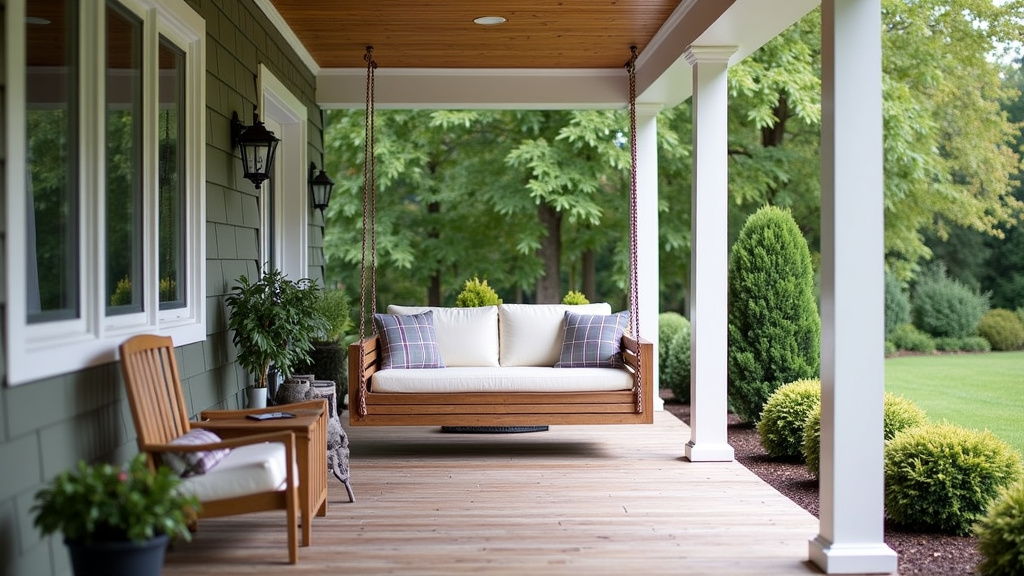
Checklist: Your Porch Swing Fit Guide
To make sure you choose the right dimensions, run through this quick checklist:
- Measure your porch width accurately.
- Measure your porch depth and note obstructions.
- Determine the desired seating capacity (1, 2, 3, or 4 people).
- Consider the seat depth and backrest angle for comfort.
- Calculate the necessary clearance for safe swinging.
- Check the swing’s overall hanging height against your porch ceiling.
Conclusion
Finding the right porch swing dimensions is simpler than you might think. We’ve learned that the 4-foot standard is a great starting point for most, offering comfort for two. If you need more space or have a smaller porch, 3-foot or 5-6-foot options are readily available. Remember to look beyond just length; seat depth and backrest angle significantly impact relaxation. Taking accurate measurements of your porch and planning for adequate clearance is your final, key step. Now you’re ready to choose a swing that fits your space and your lifestyle perfectly. For details on one popular larger size, see our 5-foot porch swing guide.
Frequently Asked Questions
What is the most common porch swing size?
The most common porch swing size is 4 feet long. This dimension is popular because it comfortably seats two adults without feeling too cramped. It’s a versatile size that fits well on many porches.
How much space do I need around a porch swing for it to move freely?
You’ll want at least 2 feet of clear space in front of and behind your porch swing. This clearance allows for safe and comfortable swaying without hitting walls or other objects. Always check the swing’s specifications for its full arc.
Can I hang a porch swing on a porch with a roof?
Yes, you can hang a porch swing on a porch with a roof, but ensure there’s enough vertical clearance. The chains or ropes add to the swing’s height. Make sure the swing won’t hit the roofline when it swings forward.
What if my porch is very narrow? Are there smaller swing options?
Absolutely. If you have a narrow porch, look for swings around 3 feet in length. These smaller options are designed for more intimate seating and fit better in tighter spaces. They can still offer a lovely place to relax.
How deep should the seat of a porch swing be for comfort?
For most adults, a seat depth between 18 to 22 inches is ideal. This range provides good leg support and allows you to settle in comfortably. Too shallow or too deep can make sitting less enjoyable.