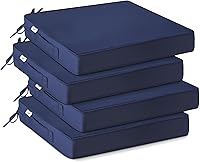
How to Choose Adirondack Chair Cushions
For adirondack chair and ottoman cushions, match the seat, back and ottoman pad to the chair's exact width, depth and slope, then pick foam thickness and straps that keep the set in place. A tight fit on all three pieces beats a soft cushion that slides or bunches.
On this page (11 sections)
- How do you measure an Adirondack chair and ottoman for cushions?
- What size seat cushion fits most Adirondack chairs?
- How tall should the back cushion be?
- How do you size the ottoman cushion?
- What attachment style keeps cushions in place?
- How thick should Adirondack chair cushions be?
- What fabric is best for outdoor Adirondack cushions?
- How do you keep Adirondack cushions clean and dry?
- Can you use one cushion set on different Adirondack chairs?
- What mistakes should you avoid when buying a cushion set?
- How do you decide which set to buy for your porch?
For adirondack chair and ottoman cushions, the right set matches three separate sizes and stays put with straps or ties. Measure before you order, because Adirondack chairs vary a lot from maker to maker.
Start with outdoor cushions as a general primer only if you need fabric basics, then focus on your chair. Standard patio cushions rarely fit the sloped back and wide seat of an Adirondack frame.
A cushion made for this shape will follow the wide arm-to-arm seat and the tall, reclined back.
Our team compared sizes, foam and fasteners across current Adirondack cushion sets. For a fabric-specific option, compare Sunbrella Adirondack cushions.
We looked at seat and back dimensions, ottoman pad size, strap length and fabric type.
The notes below explain how to pick a set that fits your frame.
How do you measure an Adirondack chair and ottoman for cushions?
Measure each surface separately, because seat, back and ottoman sizes are not interchangeable. A set that fits the chair may still be wrong for the footrest.
Measure the seat from arm to arm for width. Then measure front to back for depth at the deepest point.
Note the frame height at the back of the seat, since many Adirondack seats sit low and wide.
Measure the back from the top of the seat to the top rail. Also note the slope, because a steep back needs a shorter pad than a deep recline.
Then measure the ottoman top length, width and height.
Write down all six numbers. Compare each one to the cushion size before you buy.
A pad that is even 1 in too wide will ride up over the arms.
Measure at the narrowest point as well as the widest point. Some Adirondack seats taper slightly toward the front, so a pad that fits at the back may still catch on the front corners.
Mark the smallest width and use that as your limit for the seat pad.
Also check the width between the slats on the back. A pad that relies on ties needs slats close enough for the ties to grip without pulling the fabric into the gaps.
Note the gap size now, because it will decide whether straps or ties are the better choice later.
Rule: buy by your measured numbers, not by "standard" or "large."
What size seat cushion fits most Adirondack chairs?
A seat cushion should sit inside the arms with a small gap on each side. That gap stops the pad from bunching when you sit down.
Most full-size Adirondack seats fall in a broad range, so you must measure yours. Wide seats need a wide pad, and a narrow pad on a wide seat will drift to one side.
Check seat depth as well as width. A pad that is too deep will push up the back cushion.
A pad that is too shallow will leave the front rail exposed and feel short.
Look at the front edge shape too. Some seats have a straight front rail, and some curve.
A straight pad on a curved front can leave a gap at the corners.
If you want a starting point for shape and thickness, our guide to best adirondack chair cushions shows the common seat widths and how they suit different frames.
Consider how the seat pad meets the back pad at the join. A deep seat pad that ends right where the back pad begins will create a flat, continuous surface.
A shallow pad leaves a step, and the back pad may slide forward when you lean into it.
Rule: the seat pad must be narrower than the space between the arms.
How tall should the back cushion be?
The back cushion should cover the slats you lean against, from seat level to near the top rail. Too short and your shoulder blades hit wood.
Too long and the pad folds over the top.
Measure from the seat surface to the top of the back frame. Then subtract a small amount so the pad does not flop forward over the rail.
Pay attention to the slope. On a deep recline, the pad needs more length to follow the angle.
On a more upright chair, a shorter pad works better.
A one-piece seat and back cushion can work on some chairs. It sets the angle for you, which is good if your frame has a fixed slope.
But you cannot adjust the seat depth separately, so measure carefully.
For a chair that rocks, read best adirondack rocking chairs cushions for notes on pads that stay put when the chair moves.
Check where the back pad sits when the seat pad is in place. Foam thickness on the seat raises your starting point, so the back pad has slightly less exposed frame to cover.
Measure the back height with the seat pad already on the seat for the most accurate result.
Rule: measure back height along the slope, not straight up.
How do you size the ottoman cushion?
The ottoman cushion should cover the footrest top without overhanging the sides. An overhanging pad will slide off when you rest your feet on it.
Measure the ottoman top in both directions. Many ottomans are wider than they are deep, and the pad should match that shape.
Check the height too. A thick pad raises your feet, which changes the angle of your legs.
On a low chair, a very thick ottoman pad can feel like a step.
Ottoman pads often need their own straps. A pad that only rests on top will move with every shift of your feet.
Look for straps that wrap under the ottoman frame.
If you plan to use the ottoman as a side table as well, a thinner pad is easier to remove and store. A thick pad is better for long sits.
Seat, back and ottoman cushions explained
These three pieces work as a set. The seat pad takes your weight, the back pad takes your lean, and the ottoman pad takes your feet.
All three should be the same fabric family so they age at the same rate.
When you compare sets, check that all three pieces are included. Some sellers list a chair set without the ottoman, and some sell the ottoman pad alone.
Confirm the piece count before you order.
Thickness should also match across the set. A very thick seat pad with a thin back pad can make the chair feel uneven.
Aim for a balanced set where all three pads have similar foam depth.
Care also affects how the set ages together. If the ottoman pad is washed more often because it collects more dirt from feet, its fabric may fade faster than the chair pads.
A removable cover on the ottoman pad makes that routine easier to manage.
Rule: the ottoman pad must be strapped down, not just laid on top.
What attachment style keeps cushions in place?
Straps and ties are the most reliable option on open slat frames. Long straps that wrap fully around the frame rails hold better than short ties that only reach the nearest slat.
Look for straps at the top and bottom of the back pad. Two straps on the back pad stop it from sliding down into the seat.
Seat pads need straps on the front and back edges.
Ties work if the slats are close enough to knot through. On wide-spaced slats, ties can slip.
Velcro straps are common, but check that the strap length is long enough to wrap the full rail thickness.
A cushion with no fasteners is the weakest choice. It may look clean in a photo, but it will shift when you sit, stand and move an ottoman.
For rain-heavy use, see best adirondack chair cushions waterproof for pads with fasteners and water-ready fabrics.
Count the straps on each pad before you buy. A back pad with only one strap can pivot sideways, while two straps keep it square to the frame.
Seat pads with straps on both the front and back edges resist the forward slide that happens when you sit down.
Rule: choose straps that wrap the full frame, not short ties.
Which is better: straps, ties or no fasteners?
Straps win for most buyers because they hold on both wide and narrow slats. Velcro straps are fast to adjust and easy to remove for washing.
Ties look neat and cost less, but they need close slats to work. If your chair has wide gaps, ties will loosen over time.
No fasteners suit a cushion that you only use indoors or on a chair that rarely moves. Outdoors, the wind and daily use will move a loose pad within days.
How thick should Adirondack chair cushions be?
Thickness affects comfort and stability in different ways. A medium thickness balances padding and a secure sit.
Very thick pads can feel soft but may make the chair feel tippy.
Think about how you sit. If you sit for long periods with a book or a drink, more foam under the seat helps.
If you get up often, a thinner pad is easier to rise from.
Foam type matters as much as thickness. Dense foam holds its shape longer than soft foam.
Over a season, low-density foam packs down and leaves the slats feeling hard.
Check the cover as well. A thick pad with a loose cover can bunch.
A pad with a fitted cover and straps will keep its shape better.
For POLYWOOD frames in particular, best polywood adirondack chair cushions explains how pad thickness pairs with that frame style.
Match thickness across the seat, back and ottoman pads. A thick seat pad paired with a thin back pad can change the recline angle and push you forward.
A balanced set keeps the sitting position consistent from the seat through to the footrest.
Rule: pick medium thickness with dense foam for daily use.
What fabric is best for outdoor Adirondack cushions?
Outdoor fabric needs to handle sun, rain and dust. Solution-dyed acrylic and olefin are common choices because they resist fading and dry fairly fast.
Acrylic feels soft and holds color well. Olefin resists stains and moisture but can feel less soft.
Polyester blends are budget friendly but may fade faster in strong sun.
Check if the fabric is water resistant or water repellent. Repellent fabric sheds light rain, but it is not the same as a waterproof membrane.
In heavy rain, foam inside will still get wet.
Removable covers help with cleaning. You can wash a cover and let the foam dry on its own.
Non-removable covers need spot cleaning only.
Color choice also matters. Dark fabrics hide dirt but get hot in sun.
Light fabrics stay cooler but show stains. A mid-tone is often the easiest to live with.
If you want a bold look, best adirondack chair cushions red shows how red sets pair with each frame finish.
Fabric choice by use
Choose fabric based on where the chair sits, not only on color. A chair in full sun needs a fade-resistant fabric, while a shaded porch chair can handle a wider range of options.
A chair that collects rain needs a fabric that dries quickly and a cover you can remove to dry the foam.
Rule: choose a fade-resistant fabric with a removable cover if you can.
How do you keep Adirondack cushions clean and dry?
Clean cushions on a set schedule, not just when they look dirty. Brush off dust weekly and spot clean spills right away.
Dirt left on fabric grinds into the fibers over time.
For a deeper clean, remove the cover if it zips off. Wash with mild soap and water, then rinse well.
Let the cover air dry fully before you put it back on.
Foam itself can be rinsed and pressed, not wrung. Scrub the foam with soapy water, rinse, then press out water with towels.
Air dry the foam in shade until it is fully dry.
Store cushions indoors during heavy rain or when you will not use the chair for a while. If you must leave them out, stand them on edge so water drips off instead of pooling.
Our best pillows for adirondack chairs guide covers the extra pillows that pair with cushions, and how to keep the whole set clean.
Clean the ottoman pad more often than the back pad. Feet bring in dust and moisture, so the ottoman cover will need washing on a shorter cycle.
Keeping all three covers on the same cleaning schedule prevents one piece from looking worn while the others still look fresh.
Rule: dry cushions fully before you store them.
Can you use one cushion set on different Adirondack chairs?
Only if the frames share the same measurements. Two chairs that look alike can differ by several inches in seat width and back height.
Check the seat width, seat depth, back height and ottoman size on both chairs. If any number differs by more than about 1 in, the pad may not fit well.
The slope matters too. A pad made for a deep recline will hang loose on an upright chair.
The straps may also be the wrong length for a different rail size.
If you own two different chairs, it is smarter to buy a set for each. Swapping pads between chairs often leads to sliding and bunched fabric.
If the chairs are the same model, a shared set can work. Keep the straps adjusted for each chair, and check the fit after the first sit.
Rule: swap cushions only between chairs with matching measurements.
What mistakes should you avoid when buying a cushion set?
The most common mistake is ordering by a generic size name. "Standard" means different things to different makers.
It can describe a narrow chair or a wide one.
The second mistake is forgetting the ottoman. Many buyers order a chair set, then find the ottoman has no pad or the pad is a different color.
Order all pieces at the same time.
The third mistake is ignoring strap length. A pad can be the right size but have straps that are too short to wrap your rails.
Check strap length against your frame.
The fourth mistake is choosing a very thick pad for a low chair. Thick pads raise you up and can make the chair feel unstable.
Measure the seat height and think about how you will get up.
The fifth mistake is leaving foam wet in a closed cover. Mildew can grow fast in warm, damp fabric.
Dry everything fully before you zip and store.
Rule: confirm size, piece count and strap length before you pay.
How do you decide which set to buy for your porch?
For adirondack chair and ottoman cushions, the best set is the one that matches your three measurements and stays put with full-wrap straps. Start with the numbers, then pick fabric and thickness.
If your chair is POLYWOOD, check the POLYWOOD-specific guide first. If your chair rocks, check the rocking chair guide.
If you store cushions in rain, check the waterproof guide.
Then compare fabric, foam density and cover removability. A removable cover and dense foam will serve you longer than a soft pad with no fasteners.
Measure again if you are close between two sizes. A slightly smaller pad with good straps beats an oversized pad that folds over the arms.
Rule: buy the set that fits your measurements, all three pieces, with straps that wrap your frame.
Frequently asked questions
What size cushions fit an Adirondack chair and ottoman?
Measure the seat width and depth, the back height and slope, and the ottoman top. Choose each pad a fraction smaller than the frame so it sits inside the slats without hanging over.
A cushion that is too wide will slide sideways when you sit down.
Do Adirondack chair cushions need straps or ties?
Most Adirondack frames have open slats, so straps or ties help a lot. Look for long straps that wrap fully around the seat and back rails.
A cushion with no fasteners will shift every time you get up.
Should the ottoman cushion match the chair cushions?
A matching set looks neat and keeps the fabric wear even, but a separate ottoman pad can work if the color and thickness match. Check that the ottoman pad is thick enough to cover its slats and has its own straps.